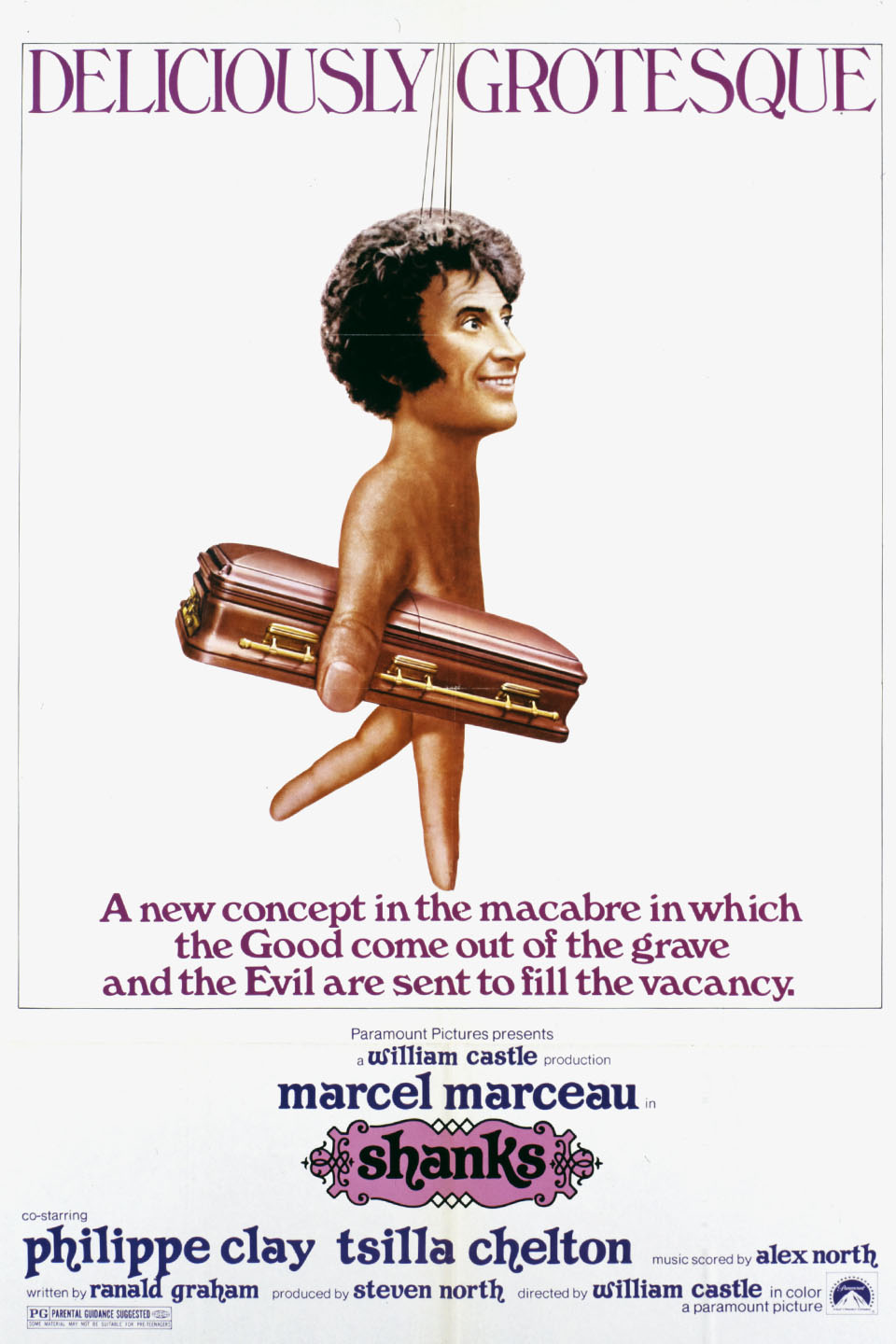
Shanks (1974) - William Castle's work I kind of find goofy, enjoyable as a kid, but they aren't films, really, they're gimmicks. And his non-horror stuff are usually sub-Disney comedies. I like his Old Dark House (1963), but that is a contemporary Hammer. But usually, they're gimmicks. And this is a gimmick - 90 minutes of Marcel Marceau in a weird kaleidoscope of 1970s suburban California and mittel-European fairyland. It's inconsequential - what you get when you spread a spesh act over 90 minutes and inflict plot on it. There's a nice Phibesy feel to the start, the haunting soundtrack by Alex North helps, it feels almost like a US attempt to do something Czech. But the domestic drama collides with the weird fantasy elements. Then, just as it everything seems sweet and nice, some rapey bikers come in. And it goes full on zombie film. An interesting effort, with its zombie-puppets, but it just feels tonally all over the place. I wonder was Castle trying to go for a Willy Wonka feel, a family film that is creepy and macabre mixed in with sweetness, but the TV-level production values and hammy cast don't help.
Friday, 16 February 2018
Shanks (1974)
Shanks (1974) - William Castle's work I kind of find goofy, enjoyable as a kid, but they aren't films, really, they're gimmicks. And his non-horror stuff are usually sub-Disney comedies. I like his Old Dark House (1963), but that is a contemporary Hammer. But usually, they're gimmicks. And this is a gimmick - 90 minutes of Marcel Marceau in a weird kaleidoscope of 1970s suburban California and mittel-European fairyland. It's inconsequential - what you get when you spread a spesh act over 90 minutes and inflict plot on it. There's a nice Phibesy feel to the start, the haunting soundtrack by Alex North helps, it feels almost like a US attempt to do something Czech. But the domestic drama collides with the weird fantasy elements. Then, just as it everything seems sweet and nice, some rapey bikers come in. And it goes full on zombie film. An interesting effort, with its zombie-puppets, but it just feels tonally all over the place. I wonder was Castle trying to go for a Willy Wonka feel, a family film that is creepy and macabre mixed in with sweetness, but the TV-level production values and hammy cast don't help.
Wednesday, 14 February 2018
Quickies again - 10- more SF, Devil's Rain, Brainstorm, Shock Waves, Woody Allen, Shadows and Fog
Under the Mountain (-1981) - TVNZ "fun", pigtailed brat in CFF-esque capers with a beach buggy versus mud-worm people. Rather silly, in a Tomorrow People-esque way. One of those kids' serials that hasn't aged well, see also Chocky (-1984).
Secret Adventures of Jules Verne (-1999-2000) - Sci-Fi Channel/CBC TV series, cheap Young Indiana Jones esque nonsense with Canadian-accented Frenchmen in Paris/Montreal, Michael Praed as Fogg. Cheaply shot on video. Imaginative, but it's all very cheesy. The curse of stupidity that most 90s SF TV suffered from (Eerie, Indiana was decent, but that was a kid's show).
Salvage-1 (=1979) - Pilot for a short-lived series, folksy Andy Griffith plays himself essentially (as he always did - apart from A Face In The Crowd), mostly a "zany"-annoying comedy, doesn't make the most of its junkyard moon-rocket recovery plot. Saddled with a mostly unappealing supporting cast. If it had been British, it'd have worked in a Wallace and Gromit way, but the American 70s US TV mix of cornball folksy types and workmanlike action doesn't do the idea justice. The main characters don't even go to the moon, they leave it to the bland support.
Planets Against Us (1962) - Italian Day The Earth Stood Still, photographed like a bad Italian b/w cop show.
Again, 50s-style SF isn't my forté. Maybe, watching too much Doctor Who weaned me off that sort. For example, the Blob (1958) looks good and has a great monster, but it is too routine, especially with its ancient teens (even if one is McQueen), and the 80s one has good visuals and some good ideas (the crazy pastor), but the 80s teen angle doesn't really interest me.
The Deadly Spawn (1983) - Fun monsters, good effects for a $20,000 budget, amateurish acting, and a lead character who reads Denis Gifford books. The best sort of low budget horror or SF - if it has a good monster or setting (at best, good monster + good setting + good cast = decent horror it works, though giant monsters are usually formulaic. All other stuff is mediocre, to say the least.
Brainstorm (1983) - Boring VR thriller, but not even this is an excuse to murder your wife. Douglas Trumbull's future as a theme park attraction designer shows. A few interesting visual camera tricks don't make a film.
Black Moon (1975) - More Louis Malle "art", i.e. mooning over a teenage girl,bathed in dubious atmosphere. Lots of pervy shots including his heroine looking over laughing kids running about naked like Ken Russell did as a child (apparently), but in a field with cows. When I watch a film, I don't want to see kids' arses. There is a nice atmosphere and some nice visuals, a sort of folk horror mood, but the kids' arses ruin it.
Devil's Rain (1975) - Despite goat-Borgnine and melting Travolta, very much a poor cousin to Race With The Devil (1975). It's slow, confused, padded out with a flashback involving a badly-dubbed Claudio Brook as a Puritan, and dead characters come back alive. WTF?
Idaho Transfer (1973) - Couldn't make it through this godawful hippiedippy Fonda futura. Shot on video, I think.
Tried watching more Woody Allen, and I can't stand his work, not because of the rumours, just never liked him, that's all. Shadows and Fog (1992) is nicely shot, despite my sort of ambivalence towards noir/expressionism. But it feels like a 90s indie film in 30s expressionist drag.
Shock Waves (1977) - Barely any Cushing, a typically wasted regional exploiter. The underwater zombie premise is neat, but little else.
Secret Adventures of Jules Verne (-1999-2000) - Sci-Fi Channel/CBC TV series, cheap Young Indiana Jones esque nonsense with Canadian-accented Frenchmen in Paris/Montreal, Michael Praed as Fogg. Cheaply shot on video. Imaginative, but it's all very cheesy. The curse of stupidity that most 90s SF TV suffered from (Eerie, Indiana was decent, but that was a kid's show).
Salvage-1 (=1979) - Pilot for a short-lived series, folksy Andy Griffith plays himself essentially (as he always did - apart from A Face In The Crowd), mostly a "zany"-annoying comedy, doesn't make the most of its junkyard moon-rocket recovery plot. Saddled with a mostly unappealing supporting cast. If it had been British, it'd have worked in a Wallace and Gromit way, but the American 70s US TV mix of cornball folksy types and workmanlike action doesn't do the idea justice. The main characters don't even go to the moon, they leave it to the bland support.
Planets Against Us (1962) - Italian Day The Earth Stood Still, photographed like a bad Italian b/w cop show.
Again, 50s-style SF isn't my forté. Maybe, watching too much Doctor Who weaned me off that sort. For example, the Blob (1958) looks good and has a great monster, but it is too routine, especially with its ancient teens (even if one is McQueen), and the 80s one has good visuals and some good ideas (the crazy pastor), but the 80s teen angle doesn't really interest me.
The Deadly Spawn (1983) - Fun monsters, good effects for a $20,000 budget, amateurish acting, and a lead character who reads Denis Gifford books. The best sort of low budget horror or SF - if it has a good monster or setting (at best, good monster + good setting + good cast = decent horror it works, though giant monsters are usually formulaic. All other stuff is mediocre, to say the least.
Brainstorm (1983) - Boring VR thriller, but not even this is an excuse to murder your wife. Douglas Trumbull's future as a theme park attraction designer shows. A few interesting visual camera tricks don't make a film.
Black Moon (1975) - More Louis Malle "art", i.e. mooning over a teenage girl,bathed in dubious atmosphere. Lots of pervy shots including his heroine looking over laughing kids running about naked like Ken Russell did as a child (apparently), but in a field with cows. When I watch a film, I don't want to see kids' arses. There is a nice atmosphere and some nice visuals, a sort of folk horror mood, but the kids' arses ruin it.
Devil's Rain (1975) - Despite goat-Borgnine and melting Travolta, very much a poor cousin to Race With The Devil (1975). It's slow, confused, padded out with a flashback involving a badly-dubbed Claudio Brook as a Puritan, and dead characters come back alive. WTF?
Idaho Transfer (1973) - Couldn't make it through this godawful hippiedippy Fonda futura. Shot on video, I think.
Tried watching more Woody Allen, and I can't stand his work, not because of the rumours, just never liked him, that's all. Shadows and Fog (1992) is nicely shot, despite my sort of ambivalence towards noir/expressionism. But it feels like a 90s indie film in 30s expressionist drag.
Shock Waves (1977) - Barely any Cushing, a typically wasted regional exploiter. The underwater zombie premise is neat, but little else.
Thursday, 8 February 2018
Quickies -30 exc. tv - some of these I barely sat through, to be honest = that bad - Slithis, Golem, Czech, Fantastic Voyage, Euro-SF
Slithis (1978) - Quirky but badly-acted. There are a few neat images - the disfigured expert, and the titular monster. But even Humanoids from the Deep did this better. As I said, the book Nightmare USA by Stephen Thrower shows that all these regional exploitation films usually have far more interesting stories behind the scenes. Even the ones with good casts tend to be oddly bland and oddly transgressive at the same time, but no real fun. For a film to be fun, a mix of good plot, good direction, good cast, good imagery.
The Golem (1979) - Actually a Polish post-apocalyptic android story, inventive but samey, all shot in a sepia tone. Elements of Gilliam and Jeunet/Caro seep in. It's quite slow, then a soft-rock escalator/concert scene lightens things up. Typical Soviet SF, but with added stock footage.
Underground (1995) - Emir Kusturica tries too hard to do Yugoslavia's Amarcord, quirky for quirky's sake, Annoyingly quirky a la the Avengers under Clemens or Gormenghast. Kusturica also behind Harry Saltzman's last production, Time of the Gypsies (1988). Not quite my thing. "Quirky".
Trouble In Mind (1985) - Dull Kris Kristofferson (my dad's hero) vs an out-of-drag Divine (my dad's nightmare) in boring "is it the future?" sub-Blade Runner neo-noir nonsense involving a baby.
Je T'aime, Je T'aime (1968) - Not very good Alain Resnais time-travel "art". Creep fails to commit suicide, and uses a giant crystalline breast-mushroom to time travel, and starts reflecting on his past. Spawned a whole subgenre of tepid Gallic time-slip thrillers.
Flesh Eaters (1964 - B/W) - Slow, though well acted and nicely shot B/W shocker, quite bloody. Though there is an annoying beatnik,Martin Kosleck good value as a Nazi scientist, but overlong. The titular monsters are just an excuse for early gore. The explosion scenes are cleverly executed, though.
Interesting how early 1930s cinema flops of international cinema like FP1 (1933 - B/W), High Treason (1929 - B/W), Just Imagine (1930 - B/W) were futuristic sci-fi nonsense. Immediate post-silent sci-fi was mostly feeble. Visually interesting at times if a little samey (like the myriad 50s jungle movies or various interchangeable low-budget 50s sci-fi movies - swap jungle for desert and little separates the Flame Barrier or Pharaoh's Curse)...
The Silence of Dr. Evans (1973) - Waterloo director Sergey Bondarchuk stars in this wondrously odd Mosfilm alien abduction drama, almost a Soviet giallo, set in either or both the US or UK, with a strange faux-Western world feel, and a Engrish-lyrics theme tune with lyrics like "you are my dream, my fairy queen", "you love so freely". A psychedelic thriller that almost feels like it was made by aliens, especially in its preachy message about aliens being too smart for Earth. The air crash is particularly well done, with Indians meditating as they die.
Lobster Man From Mars (1989) - A shite Matinee with Tony Curtis. Seemingly set in the modern day when it should be the 50s.
Malevil (1981) - Fil (or considering it features the likes of Jean-Louis Trintignant, Le Lendemain). Depressing.
The Manster (1959 - B/W) - "American" in Japan played by Peter Dyneley (the unmistakable voice of Jeff Tracy in Thunderbirds) grows two heads. Caught between two stools - schlocky US sci-fi focused on one idea and running with it, that if you swapped 75% with another SF film of the same time, no one would notice, and the stranger, more ideas-based Japanese sort, but the head-growth scenes and rampage are fun.
Blue Sunshine (1978) - A horror for hippies, i.e. about going bald. Otherwise not much flack. The Crazies but bald.
The Lathe Of Heaven (TV- 1981) - Though shot on film, this PBS one-off feels like a US equivalent of Plays for Today like The Flipside of Dominick Hide. Dull, although Kevin Conway gives a good performance.
The Lucifer Complex (1978) - Why are Keenan Wynn and Robert Vaughn in a stitch of random footage that pretends to be a ripoff of the Boys from Brazil?
Lifespan (1976) - Forgettable Anglo-Dutch clone-y thriller.
The Lift (1983) - Dutch killer lift in dystopian future schlock, played too seriously. Jokey concept more suited to an Amicus anthology. Eventually the last segment becomes incredibly tense and atmospheric, but it is too late.
The Neptune Factor (1973) - All-star Canadian disaster movie actually a tax shelter excuse to pad undersea wildlife footage.
Again, there were very few good Canadian films of this era. I even found voodoo killer-child nonsense Cathy's Curse (1977) a load of cobblers, and not even visually awesome like The Visitor (-1979). See also the space-Beachcombers boredom of Starship Invasions (1977).
Rat Saviour (1976)- Attractive period Yugoslavian setting hides rat mutations, in what in the 1950s would be a typically stupid bland American horror, is a well-produced gothic thriller in Yugoslavia.
The Bubble (1966) - No budget, just an abandoned fairground and western town and suspended Halloween masks - and an excuse for 3D.
Amphibian Man (1962) - More Soviet SF, from Lenfilm, though imported to US TV by National Telefilm Associates. Imagine Creature from the Black Lagoon via Tales from Europe, with all the sentimentality pushed to the forefront.
Acción Mutante (1993) - Loud, brash, horribly unlikeable - styled like a terrorist recruitment film, and as the Radio Times put it, "terminally camp". The characters don't appeal.
Coma (-1978) - Boring 1970s pseudo-SF thriller. A typical 70s medical drama with conspiracy thriller elements. Maybe it is because God Genevieve Bujold is a very stiff actress.
A Nice Plate of Spinach (1978) - a rejuvenation-themed Czech comedy with many of the same cast as Tomorrow, I Shall Wake Up And Scald Myself With Tea (1978), but does not quite translate as well, despite a fun feel, it's just children with adult voices, and adults with children's voices fighting like babies resulting in slapstick fun. Though there is fun in a kitchen, which is always a plus.
Long Live Ghosts! (1977) - Oldrich Lipsky's Barrandov-shot Czech Children's Film Foundation-esque "kids meets ghost girl" comedy, Czech 3 Investigators at Motley Hall.See also the similarly CFF-ish Saxana by Nice Plate of Spinach director Vaclav Vorlicek. (1972).
Read today that Fantastic Voyage (1966) was intended as a period piece. It might have worked better that way. It feels too much like an Irwin Allen TV show, with its gung-ho attitude to scientific problems.
Also watched Supermarionation-via Button Moon German kids TV fluff Robbi, Tobbi und Das Fliewatuut, was left unamused by the Rivals of Sherlock Holmes and laughed at the pantosploitation joy of The Steam Video Company.
The Golem (1979) - Actually a Polish post-apocalyptic android story, inventive but samey, all shot in a sepia tone. Elements of Gilliam and Jeunet/Caro seep in. It's quite slow, then a soft-rock escalator/concert scene lightens things up. Typical Soviet SF, but with added stock footage.
Underground (1995) - Emir Kusturica tries too hard to do Yugoslavia's Amarcord, quirky for quirky's sake, Annoyingly quirky a la the Avengers under Clemens or Gormenghast. Kusturica also behind Harry Saltzman's last production, Time of the Gypsies (1988). Not quite my thing. "Quirky".
Trouble In Mind (1985) - Dull Kris Kristofferson (my dad's hero) vs an out-of-drag Divine (my dad's nightmare) in boring "is it the future?" sub-Blade Runner neo-noir nonsense involving a baby.
Je T'aime, Je T'aime (1968) - Not very good Alain Resnais time-travel "art". Creep fails to commit suicide, and uses a giant crystalline breast-mushroom to time travel, and starts reflecting on his past. Spawned a whole subgenre of tepid Gallic time-slip thrillers.
Flesh Eaters (1964 - B/W) - Slow, though well acted and nicely shot B/W shocker, quite bloody. Though there is an annoying beatnik,Martin Kosleck good value as a Nazi scientist, but overlong. The titular monsters are just an excuse for early gore. The explosion scenes are cleverly executed, though.
Interesting how early 1930s cinema flops of international cinema like FP1 (1933 - B/W), High Treason (1929 - B/W), Just Imagine (1930 - B/W) were futuristic sci-fi nonsense. Immediate post-silent sci-fi was mostly feeble. Visually interesting at times if a little samey (like the myriad 50s jungle movies or various interchangeable low-budget 50s sci-fi movies - swap jungle for desert and little separates the Flame Barrier or Pharaoh's Curse)...
The Silence of Dr. Evans (1973) - Waterloo director Sergey Bondarchuk stars in this wondrously odd Mosfilm alien abduction drama, almost a Soviet giallo, set in either or both the US or UK, with a strange faux-Western world feel, and a Engrish-lyrics theme tune with lyrics like "you are my dream, my fairy queen", "you love so freely". A psychedelic thriller that almost feels like it was made by aliens, especially in its preachy message about aliens being too smart for Earth. The air crash is particularly well done, with Indians meditating as they die.
Lobster Man From Mars (1989) - A shite Matinee with Tony Curtis. Seemingly set in the modern day when it should be the 50s.
Malevil (1981) - Fil (or considering it features the likes of Jean-Louis Trintignant, Le Lendemain). Depressing.
The Manster (1959 - B/W) - "American" in Japan played by Peter Dyneley (the unmistakable voice of Jeff Tracy in Thunderbirds) grows two heads. Caught between two stools - schlocky US sci-fi focused on one idea and running with it, that if you swapped 75% with another SF film of the same time, no one would notice, and the stranger, more ideas-based Japanese sort, but the head-growth scenes and rampage are fun.
Blue Sunshine (1978) - A horror for hippies, i.e. about going bald. Otherwise not much flack. The Crazies but bald.
The Lathe Of Heaven (TV- 1981) - Though shot on film, this PBS one-off feels like a US equivalent of Plays for Today like The Flipside of Dominick Hide. Dull, although Kevin Conway gives a good performance.
The Lucifer Complex (1978) - Why are Keenan Wynn and Robert Vaughn in a stitch of random footage that pretends to be a ripoff of the Boys from Brazil?
Lifespan (1976) - Forgettable Anglo-Dutch clone-y thriller.
The Lift (1983) - Dutch killer lift in dystopian future schlock, played too seriously. Jokey concept more suited to an Amicus anthology. Eventually the last segment becomes incredibly tense and atmospheric, but it is too late.
The Neptune Factor (1973) - All-star Canadian disaster movie actually a tax shelter excuse to pad undersea wildlife footage.
Again, there were very few good Canadian films of this era. I even found voodoo killer-child nonsense Cathy's Curse (1977) a load of cobblers, and not even visually awesome like The Visitor (-1979). See also the space-Beachcombers boredom of Starship Invasions (1977).
Rat Saviour (1976)- Attractive period Yugoslavian setting hides rat mutations, in what in the 1950s would be a typically stupid bland American horror, is a well-produced gothic thriller in Yugoslavia.
The Bubble (1966) - No budget, just an abandoned fairground and western town and suspended Halloween masks - and an excuse for 3D.
Amphibian Man (1962) - More Soviet SF, from Lenfilm, though imported to US TV by National Telefilm Associates. Imagine Creature from the Black Lagoon via Tales from Europe, with all the sentimentality pushed to the forefront.
Acción Mutante (1993) - Loud, brash, horribly unlikeable - styled like a terrorist recruitment film, and as the Radio Times put it, "terminally camp". The characters don't appeal.
Coma (-1978) - Boring 1970s pseudo-SF thriller. A typical 70s medical drama with conspiracy thriller elements. Maybe it is because God Genevieve Bujold is a very stiff actress.
A Nice Plate of Spinach (1978) - a rejuvenation-themed Czech comedy with many of the same cast as Tomorrow, I Shall Wake Up And Scald Myself With Tea (1978), but does not quite translate as well, despite a fun feel, it's just children with adult voices, and adults with children's voices fighting like babies resulting in slapstick fun. Though there is fun in a kitchen, which is always a plus.
Long Live Ghosts! (1977) - Oldrich Lipsky's Barrandov-shot Czech Children's Film Foundation-esque "kids meets ghost girl" comedy, Czech 3 Investigators at Motley Hall.See also the similarly CFF-ish Saxana by Nice Plate of Spinach director Vaclav Vorlicek. (1972).
Read today that Fantastic Voyage (1966) was intended as a period piece. It might have worked better that way. It feels too much like an Irwin Allen TV show, with its gung-ho attitude to scientific problems.
Also watched Supermarionation-via Button Moon German kids TV fluff Robbi, Tobbi und Das Fliewatuut, was left unamused by the Rivals of Sherlock Holmes and laughed at the pantosploitation joy of The Steam Video Company.
The Games (1970)
Despite being a Michael Winner film, my allergy to sports movies and Ryan O'Neal (because he's a faux-Irish arsehole) and slight trepidation when it comes to Michael Crawford, spurred on by years of watching Some Mothers with the gran. It certainly catches the dynamic nature of sports, and the early US scenes (moustache-free Sam Elliott!) are a tantalising glimpse of what Winner could have done with a a US college sex comedy. The Australia scenes pack a punch. And the foreign locations are well-captured. I wish Winner had directed something else down under. Crawford is very Frank in it, a childlike milkman slurping from two straws. The stock footage of Prague seems to be shot from a distance with a handheld camera in secret. Charles Aznavour's quite decent. Stanley Baker does gruff, looking like a middle-aged dad trying to emulate Ringo Starr. The plastic spectators in the stadium are obvious. Weird that Oliver Reed isn't in it, especially as Kent Smith is (who played Oliver Reed in Cat People). In all, a bit of a slog.
Wednesday, 7 February 2018
The Last Hunter
The Last Hunter (1980) - Antonio Margheriti's funk-soundtracked Deer Hunter knockoff, some impressive pyrotechnics and action sequences (especially the opening sequence) can't polish a typical duff Italian war movie. David Warbeck's Brut-strewn divorced dad "charm" remains, even when dubbed. The end theme is a bizarrely out of place nasal disco sub-Barry Manilow muse on war that sounds quite a bit like the theme to the Pumaman. Tisa Farrow, the presumably less mental sister of Mia (though considering that family's roots lie partly in Boyle*, perhaps not) plays a journalist. Some inappropriately jolly When I'm 64-alike music accompanies an out of place jungle football scene. The "New York" scenes are clearly Warbeck and co in an Italian park while cutting to some second unit of people in Manhattan staring at a Cutty Sark-type windjammer. I am still fascinated by Italian exploitation, even though much of it (especially the 60s stuff) is utterly interchangeable, and most of it almost unwatchable. But somehow seeing Italian exploitation hacks trying to imitate a "serious", and over-rated American film like The Deer Hunter AND Apocalypse Now is more fun, because it's played so earnestly.They put some effort in it, and yet there's still enough blatant cheek there. Margheriti's films tend to have action, but they always feel hollow. His Indiana Jones knockoffs like Hunters of the Golden Cobra and Ark of the Sun God (1982) are less glossy than Last Hunter, with scenes clearly shot on short ends without a script, guerrilla-style. They feel amateurish, more like those teenage fans' recreation of Raiders than even say, King Solomon's Mines (1985).
That whole Vietnam war canon is kind of boring, even the knock-offs - although I do like Ted Kotcheff's Uncommon Valor (1983) for some reason. Maybe, cos it is somewhere between intelligent treatise on war and Rambo-ish "bring back our boys" mindless action, predating First Blood Part II, and there's an adventure element, which is usually what a war film needs for me to enjoy it, i.e. why I enjoy Von Ryan's Express but not The Great Escape.
*Not to be rude to the people of Roscommon, I've been to Boyle. It's great, but the Sky sitcom Moone Boy set there is kind of true, everyone there is at least joyfully bonkers.
Tuesday, 6 February 2018
Soviet SF roundup - 24
Sex Mission (1984) - An interesting satiric prologue with lots of 80s neon devolves into a Polish Worm that Turned with a sperm fetish.
End of August at Hotel Ozone (1967) - Czech New Line release. Like Stalker (1979) and the always yellow-tinted junkpunk kitchen sink drudgery of Konstantin Lopushanskiy's Lenfilm ventures Letters from a Dead Man (1985, like Stalker and Dead Mountaineer's Hotel (1978), a Strugatsky adaptation) and Visitor to a Museum (1989), in that realm of Eastern European post-apocalyptic films that are just walks about desolate countryside, and enjoyed by people who don't live in desolate countryside unlike myself, so it isn't special. Though it is lovingly black and white, bleak, beautiful, like White Horses gone Threads.
War of the Worlds - Next Century (1981)/O-Bi, O-Ba: End of Civilisation (1985) - Both Polish post-apocalyptica, both starring Jerzy Stuhr (also in ITC Popesploitation From A Far Country). War of the Worlds is not a HG Wells adaptation, but a rather dry but occasionally visually stimulating satire set in a far-future England with a major plot point based on the licence fee. O-Bi, O-Ba features glitter-glossed females, lots of neon in among walls of piled-up junk, so nice junkpunk design, lots of blue, looks like how Von Trier should have shot The Element of Crime. A stunning, Gilliamesque climax in the snow with a hot air balloon revealed to be the hero's sacred "Ark", a sign of the film's (to quote tasteofcinema.com) "caustic" wit.
Kin-Dza-Dza (1986) - Nice desert locations in a Beckett-esque comedy. Two blokes, including a Russian punk are transported to a junkpunk dystopian wasteland, suddenly via pressing a vagrant's futuristic watch and a cut, and spend times with men in junky outfits, dressed like stretched Time Bandits. Amusing but overlong.
Gorod Zero (1989) - Like the above, also from Mosfilm, a darkly humorous mystery/bureaucratic satire whose weird dieselpunk setting I can't ascertain if it is deliberate or just a product of being made in the USSR. A memorable touch is the full-size carousel dioramas housing human bodies, all of whom look like the cast of a Soviet Young Ones.
Watched 1936 Mosfilm epic Cosmic Voyage (1936), which though not great, has like Aelita (1924), epic Things to Come -ish visuals, and the less impressive, more prosaic Karel Capek homage Gibel Sensatsii (1936), starring Sergey Martinson, Frankland in the 1981 Lenfilm Hound of the Baskervilles.
A lot of the 60s Soviet space operas look the same, but completely different to any Western SF, except perhaps sporadically, the odd bit of Italian schlock like Battle of the Worlds and Planet of the Vampires (1965). The strange settings and well-done FX and adult nature contrasted with the imported AIP-bought B-movie future of A Dream Come True (with its holiday camp space centre), Dovzhenko-Kiev's Battle Beyond the Sun, the Czech Radio Luxembourg-referencing AIP-TV comedy Man in Outer Space/Man from The First Century, Planeta Bur, the East German effort First Spaceship on Venus (actually, Crown Int. but still...) and the even more different Ikarie XB-1 (shot in B/W and featuring expensive dining parties in space). But they are still more trad Western sci-fi than the later, stranger SF to come out of Eastern Europe, though there were still worthy but dull-though-occasionally-sparky stuff like Stanislaw Lem android party Pilot Pirx's Inquest (1978), and the interminable likes of Mosfilm's trippy but outmoded psychodrama Moon Rainbow (1984), which features a sub-Moonraker laser beam fight, and Antonio Margheriti-esque Star Inspector (1980), which mixed in a ripoff of a vague description of Star Wars which b/w besuited exposition ghosts and a naked baby chasing horses. These Mosfilm ventures were rivalled by the ambitious but like most Soviet space-goers, rather stiff and old-fashioned Ukrainian Orion's Loop (1982), with Anatoliy Mateshko, director of such films as Sony Pictures Classics' A Friend of the Deceased (1997) as well as British characters who are Russian-accented men speaking English in front of various black and Indian people, and an Obi Wan-ish ghost exposition man. There was also the MST3K-riffed Gorky Film Studio production Through The Thorns of the Stars (1981), which has Superman-esque titles, looks fabulous but is rather staid, but is rather cold, and feels sometimes like a space Emanuelle film. Gorky also made the CFF-with-a-huge-budget Teens in the Universe films.
East Germany's SF continued with the more 2001-ish but still fairly clinical Eolomea (1973) - which, per most Eastern Bloc SF has a genuinely shonky giant stereotyped toy robot that waddles about, and In the Dust of the Stars (1976), which feels like an Eastern Bloc remake of Space: 1999. with a Eurovision-y girl group ballad theme, and space-buses that look like rubbish trucks, in some sandy desert quarry (the default setting of every Eastern European space movie), but still quite humourless despite the weird trampoline and snake dance disco sequences by Pan's People-types in filmy dresses to Krautrock. And it all ends with a mine of Beneath the Planet of the Apes-esque slaves breaking out and walking through bleak scenic backgrounds including a weird stone circle on a cliff.
On The Silver Globe (1978) - Visually compelling but overlong and nonsensical unfinished Zulawski epic. Like the first 30 seconds of the video for Loverboy by Billy Ocean, over two hours, without the funny puppets.
End of August at Hotel Ozone (1967) - Czech New Line release. Like Stalker (1979) and the always yellow-tinted junkpunk kitchen sink drudgery of Konstantin Lopushanskiy's Lenfilm ventures Letters from a Dead Man (1985, like Stalker and Dead Mountaineer's Hotel (1978), a Strugatsky adaptation) and Visitor to a Museum (1989), in that realm of Eastern European post-apocalyptic films that are just walks about desolate countryside, and enjoyed by people who don't live in desolate countryside unlike myself, so it isn't special. Though it is lovingly black and white, bleak, beautiful, like White Horses gone Threads.
War of the Worlds - Next Century (1981)/O-Bi, O-Ba: End of Civilisation (1985) - Both Polish post-apocalyptica, both starring Jerzy Stuhr (also in ITC Popesploitation From A Far Country). War of the Worlds is not a HG Wells adaptation, but a rather dry but occasionally visually stimulating satire set in a far-future England with a major plot point based on the licence fee. O-Bi, O-Ba features glitter-glossed females, lots of neon in among walls of piled-up junk, so nice junkpunk design, lots of blue, looks like how Von Trier should have shot The Element of Crime. A stunning, Gilliamesque climax in the snow with a hot air balloon revealed to be the hero's sacred "Ark", a sign of the film's (to quote tasteofcinema.com) "caustic" wit.
Kin-Dza-Dza (1986) - Nice desert locations in a Beckett-esque comedy. Two blokes, including a Russian punk are transported to a junkpunk dystopian wasteland, suddenly via pressing a vagrant's futuristic watch and a cut, and spend times with men in junky outfits, dressed like stretched Time Bandits. Amusing but overlong.
Gorod Zero (1989) - Like the above, also from Mosfilm, a darkly humorous mystery/bureaucratic satire whose weird dieselpunk setting I can't ascertain if it is deliberate or just a product of being made in the USSR. A memorable touch is the full-size carousel dioramas housing human bodies, all of whom look like the cast of a Soviet Young Ones.
Watched 1936 Mosfilm epic Cosmic Voyage (1936), which though not great, has like Aelita (1924), epic Things to Come -ish visuals, and the less impressive, more prosaic Karel Capek homage Gibel Sensatsii (1936), starring Sergey Martinson, Frankland in the 1981 Lenfilm Hound of the Baskervilles.
A lot of the 60s Soviet space operas look the same, but completely different to any Western SF, except perhaps sporadically, the odd bit of Italian schlock like Battle of the Worlds and Planet of the Vampires (1965). The strange settings and well-done FX and adult nature contrasted with the imported AIP-bought B-movie future of A Dream Come True (with its holiday camp space centre), Dovzhenko-Kiev's Battle Beyond the Sun, the Czech Radio Luxembourg-referencing AIP-TV comedy Man in Outer Space/Man from The First Century, Planeta Bur, the East German effort First Spaceship on Venus (actually, Crown Int. but still...) and the even more different Ikarie XB-1 (shot in B/W and featuring expensive dining parties in space). But they are still more trad Western sci-fi than the later, stranger SF to come out of Eastern Europe, though there were still worthy but dull-though-occasionally-sparky stuff like Stanislaw Lem android party Pilot Pirx's Inquest (1978), and the interminable likes of Mosfilm's trippy but outmoded psychodrama Moon Rainbow (1984), which features a sub-Moonraker laser beam fight, and Antonio Margheriti-esque Star Inspector (1980), which mixed in a ripoff of a vague description of Star Wars which b/w besuited exposition ghosts and a naked baby chasing horses. These Mosfilm ventures were rivalled by the ambitious but like most Soviet space-goers, rather stiff and old-fashioned Ukrainian Orion's Loop (1982), with Anatoliy Mateshko, director of such films as Sony Pictures Classics' A Friend of the Deceased (1997) as well as British characters who are Russian-accented men speaking English in front of various black and Indian people, and an Obi Wan-ish ghost exposition man. There was also the MST3K-riffed Gorky Film Studio production Through The Thorns of the Stars (1981), which has Superman-esque titles, looks fabulous but is rather staid, but is rather cold, and feels sometimes like a space Emanuelle film. Gorky also made the CFF-with-a-huge-budget Teens in the Universe films.
East Germany's SF continued with the more 2001-ish but still fairly clinical Eolomea (1973) - which, per most Eastern Bloc SF has a genuinely shonky giant stereotyped toy robot that waddles about, and In the Dust of the Stars (1976), which feels like an Eastern Bloc remake of Space: 1999. with a Eurovision-y girl group ballad theme, and space-buses that look like rubbish trucks, in some sandy desert quarry (the default setting of every Eastern European space movie), but still quite humourless despite the weird trampoline and snake dance disco sequences by Pan's People-types in filmy dresses to Krautrock. And it all ends with a mine of Beneath the Planet of the Apes-esque slaves breaking out and walking through bleak scenic backgrounds including a weird stone circle on a cliff.
On The Silver Globe (1978) - Visually compelling but overlong and nonsensical unfinished Zulawski epic. Like the first 30 seconds of the video for Loverboy by Billy Ocean, over two hours, without the funny puppets.
Some more reviews - 3 -Persecution, Lucky Touch, Gargantuas
Persecution (1974) - Young Ralph Bates smothers Lana Turner's cat in
milk. Something about revenge. A bit Thriller-ish. Not very good.
Unless you have a fetish for drowning cats in milk, and bestial
necrophiliac psycho-traumas that cause a grown man's voice to change
backwards. British cat-monster films tend to be awful. See also The Legacy (1978) and the semi-Amicus awfulness of Cat People (1982).
War of the Gargantuas (1968) has an on-film music show, with a song about "hidden microphone in my heart" in between the two hairy men fighting. Aside from the stunning climactic shot of two creatures fighting as they fall into an exploding volcano, typical Japnese kaiju schlock.
That Lucky Touch (1975) - Military-themed romcom with Roger Moore and Susannah York that is tonally awkward, like an episode of the Persuaders. Not great. Needed to be more of an adventure.
War of the Gargantuas (1968) has an on-film music show, with a song about "hidden microphone in my heart" in between the two hairy men fighting. Aside from the stunning climactic shot of two creatures fighting as they fall into an exploding volcano, typical Japnese kaiju schlock.
That Lucky Touch (1975) - Military-themed romcom with Roger Moore and Susannah York that is tonally awkward, like an episode of the Persuaders. Not great. Needed to be more of an adventure.
Subscribe to:
Comments (Atom)